Office doors are more than just entry points; they are the first point of contact for employees and clients, reflecting your company’s identity and professional style. Choosing the right door requires a balance of aesthetics, functionality, and Feng Shui. In this guide, Co-IDB provides detailed insights into selecting the perfect office doors and explores the most trending models today.
Selection Criteria for Office Doors
Choosing by Color Psychology
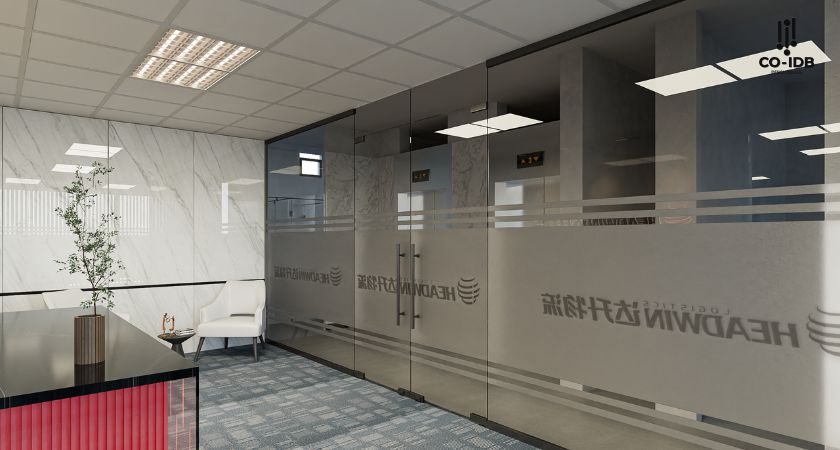
Office doors—including main entrances, internal partitions, and windows—play a pivotal role in visual impact. The main entrance should feature bold, brand-aligned colors to leave a lasting impression on partners. For internal doors and windows, simplicity and synchronization with the wall colors are recommended to maintain a clean, professional flow. In compact offices, minimalist designs help create an airy and expansive feel.
Choosing by Material Durability
The selection of materials determines the longevity and maintenance requirements of your doors. Options range from glass and wood to iron and stainless steel. Currently, aluminum-glass systems are the most popular due to their superior durability, modern look, and lightweight properties.
Choosing by Architectural Style
Door styles define the office’s design language and help zone different departments. In modern office fit-outs, minimalism is the gold standard. Opting for sleek, clean-lined designs ensures a unified and sophisticated workspace.
>> Explore: Comprehensive Office Interior Construction at Co-IDB
Popular Office Door Types Today
1. Industrial Iron & Metal Doors
A traditional choice for many Vietnamese enterprises, though increasingly replaced by lighter materials.
- Pros: Exceptional rigidity, high impact resistance, and long-term durability when properly treated.
- Cons: High structural weight, potential for oxidation (rust) if not maintained, and significant noise during operation.
2. Frameless & Tempered Glass Doors
A favorite in high-end office fit-out projects, these systems prioritize transparency and light flow.
- Pros: Maximizes natural daylight, creates a sense of openness, and offers a contemporary, high-tech aesthetic.
- Cons: Limited thermal insulation (can increase room temperature) and requires high-quality tempered glass for safety.

3. Office Roller Shutters
Typically used for main storefronts or secure storage zones.
- Pros: Exceptional space-saving (vertical operation) and high-level security against intrusion.
- Cons: Operational noise and lower acoustic insulation compared to hinged doors.
4. Wooden Door Systems
Natural Wood
Known for its prestigious appeal and intricate craftsmanship, ideal for executive suites.
- Pros: Luxurious textures, warmth, and high durability.
- Cons: Susceptible to warping in humid climates and significantly higher investment costs.
Engineered Wood (MDF/HDF)
The modern alternative that balances aesthetics with cost-efficiency. These are crafted using wood fibers and resins under high-pressure technology.
- Pros: Diverse wood grain finishes, stable structure (less prone to warping), and budget-friendly.
- Cons: Cannot be carved with intricate traditional patterns like natural wood.
Feng Shui Standards for Office Entrances
Adhering to Lu Ban dimensions is crucial for attracting positive energy (Qi) to the business.
Single-Leaf Door Dimensions
Standard for smaller offices. Ideal dimensions (including 4.5cm frame) are often 810 x 2120 mm.
Double-Leaf Door Dimensions
Common for main internal corridors. Reference standard Feng Shui dimensions:
| Frame Thickness (mm) | Height (mm) | Width (mm) |
|---|---|---|
| 45 | 2165 | 1180 – 1620 – 1850 |
| 60 | 2180 | 1210 – 1650 – 1880 |
Four-Leaf Door Dimensions (Main Entrances)
Best for wide facades and high-traffic lobbies. Common heights range from 2165mm to 2180mm with widths up to 3720mm, depending on the architectural scale.

Choosing the right office door system is a strategic investment in security, branding, and employee well-being. For expert consultation on Feng Shui standards and technical installation, contact Co-IDB today!
Explore more: