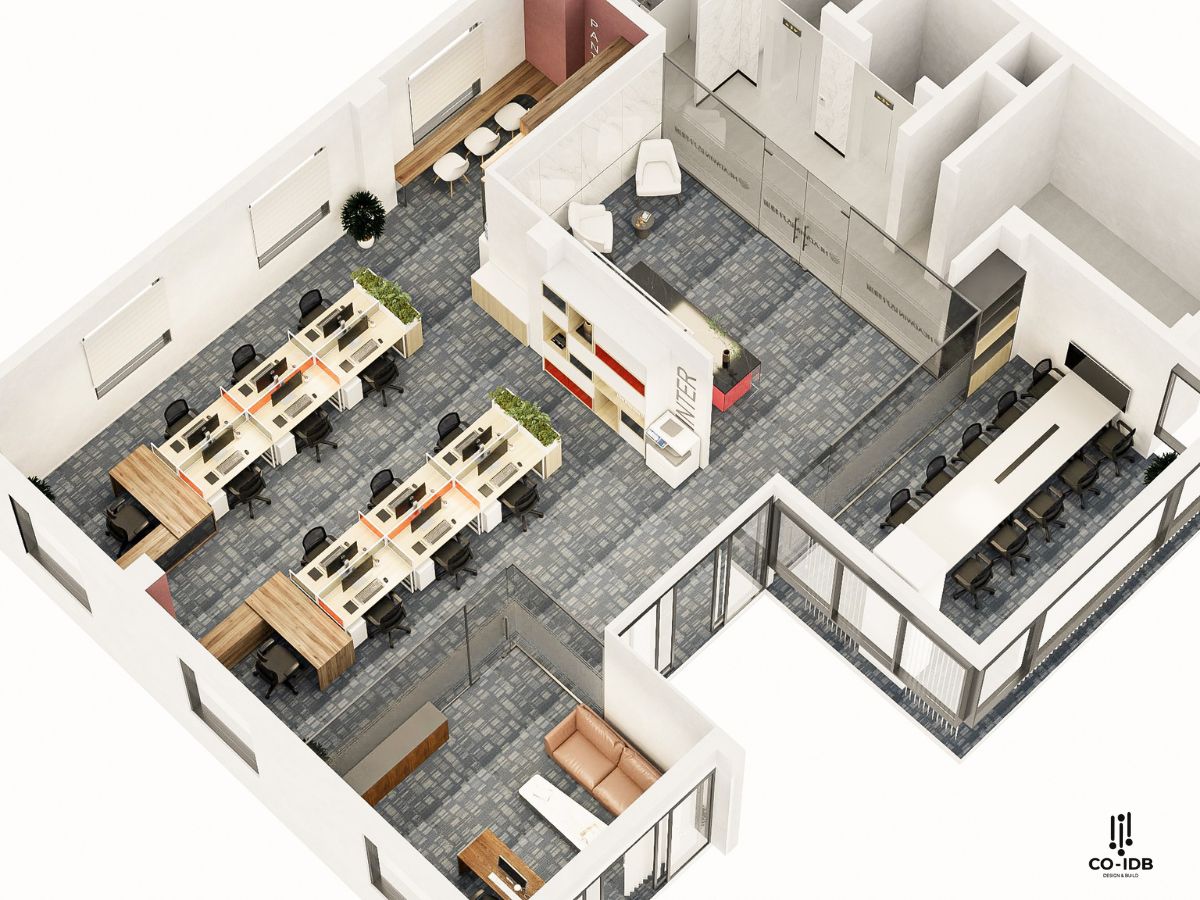
Office space design standards are a crucial factor to consider during the design process to ensure that the functionality of each department is optimized. However, many businesses are still uncertain about how to accurately calculate their office area. If you share these concerns, let Co-IDB help you find the answers in the article below!

Why Calculate Based on Office Space Design Standards?
Calculating based on established standards affects many aspects of the work environment and business efficiency because:
-
Space Optimization: Accurate calculation ensures efficient space usage, reduces construction costs, and creates a suitable working environment.
-
Health and Comfort: Proper office size and layout improve comfort, reduce stress, and prevent health issues, thereby increasing productivity.
-
Scalability: Flexible design allows for easy adjustments or expansion as the business grows or changes.
-
Encouraging Collaboration: Arranging space to promote communication and teamwork increases innovation and problem-solving capabilities.
-
Regulatory Compliance: Ensures safety and health standards are met, including adequate space, lighting, and ventilation.

Calculating Area for Each Office Zone
Calculating Staff Office Area
Different types of employees have varying needs for office space, with specific minimum and maximum standards. To better understand how to calculate the appropriate area for staff, refer to the standard table below.
| Employee Classification | Nature of Work | Appropriate Area |
| Fixed Employees | Work at a dedicated desk 6-8 hours/day (60% of time). Roles such as administrative assistants, analysts, and call center operators require space for furniture, PCs, and storage. | Max: 4.5m²/person Cost-effective: 3.5m²/person Spacious: 7-10m²/person |
| Flexible Employees | Work at a desk about 40% of the time. Positions like managers, journalists, and sales reps need airy workspaces with wide walkways. | Max: 3m²/person |
| Mobile Employees | Frequently on the move, no fixed seat required. Roles like field engineers, reporters, or consultants primarily work off-site. | Max: 1.5m²/person |

Calculating Executive Office Area
Executive offices for managers, directors, or CEOs must ensure maximum privacy and comfort. However, the director’s office should not be excessively larger than common areas or meeting rooms to maintain balance. Here are some standards to help achieve a Grade A office design:
-
General Director/CEO Office: Maximum 25m²/person.
-
Manager/Director Office: 10 – 18.5m²/person.
Executive rooms usually house only one person, making these dimensions reasonable. Besides a desk, the room can accommodate cabinets, decor, plants, or feng shui aquariums for luck and prosperity.

-
For Small Companies: Executive areas can be smaller than standard and use open designs to optimize space.
-
For Large Enterprises: Can choose between open or closed director offices based on preference, provided they harmonize with the overall design.
Calculating Meeting Room Area
Like other departments, meeting rooms need reasonable dimensions to optimize both function and aesthetics. A room that is too small feels cramped and stifling, while one that is too large causes distractions. Refer to these standards:
-
4-person Meeting Room: 7.5m² – 8m²
-
8-person Meeting Room: 15m²
-
12-person Meeting Room: 20m²
-
20-person Meeting Room: 40m²
-
> 20-person Meeting Room: 80m² – 100m²

Calculating Reception Area
The reception area usually takes up a significant portion, averaging 10m² – 20m² depending on the office scale. For medium and small office buildings, businesses should carefully choose a design that doesn’t overwhelm the lobby space.

Calculating Walkway Area
-
Primary Walkways: These connect major areas. Standard width should be at least 1.2m for two people to pass comfortably.
-
Secondary Walkways: Smaller paths within work zones, typically 0.8m – 1m wide.

Minimum Corridor Width
-
Main Corridors: Minimum width is 1.2m. For public buildings, this may increase to 1.5m – 2m for high traffic and fire escape requirements.
-
Sub-Corridors: Minimum width is usually 0.9m to 1m.

Steps to Build a Proper Office Design Standard
Allocating Space for Furniture and Equipment
Office area must account for the footprint of furniture like desks, chairs, cabinets, printers, and photocopiers:
- Office Furniture: Standard desk heights in Vietnam are 700mm to 760mm. The ideal distance from the table surface to the seat is 280-320mm. Under-desk space should have a minimum height of 580mm and width of 520mm.
- Office Equipment: Projectors and speakers should be wall-mounted to save floor space. Place shared printers and photocopiers in less-used corners to improve aesthetics and space utility.
>> See more: Office Interior Design Standards

Choosing Between Open and Closed Spaces
Every employee needs a mix of interactive and focused spaces. Modern businesses often choose a hybrid model—balancing common areas for communication with private spaces for concentration. Additional area must be calculated for partitions and circulation paths.

Ensuring Standards for Lighting and Ventilation
Lighting and HVAC are indispensable. Lighting systems (LED, natural light) are usually ceiling-mounted, but high clearances and large windows are necessary. Ventilation systems (AC, exhaust fans) also occupy ceiling space and must be planned logically to avoid overlapping electrical circuits.
>>See more: Office Restroom Design Standards

Office space design standards are the key to optimizing your workspace and enhancing productivity. Choosing the right furniture and layout creates a comfortable, efficient environment. If you have any further questions, contact Co-IDB for immediate professional consultation.
>> See more: