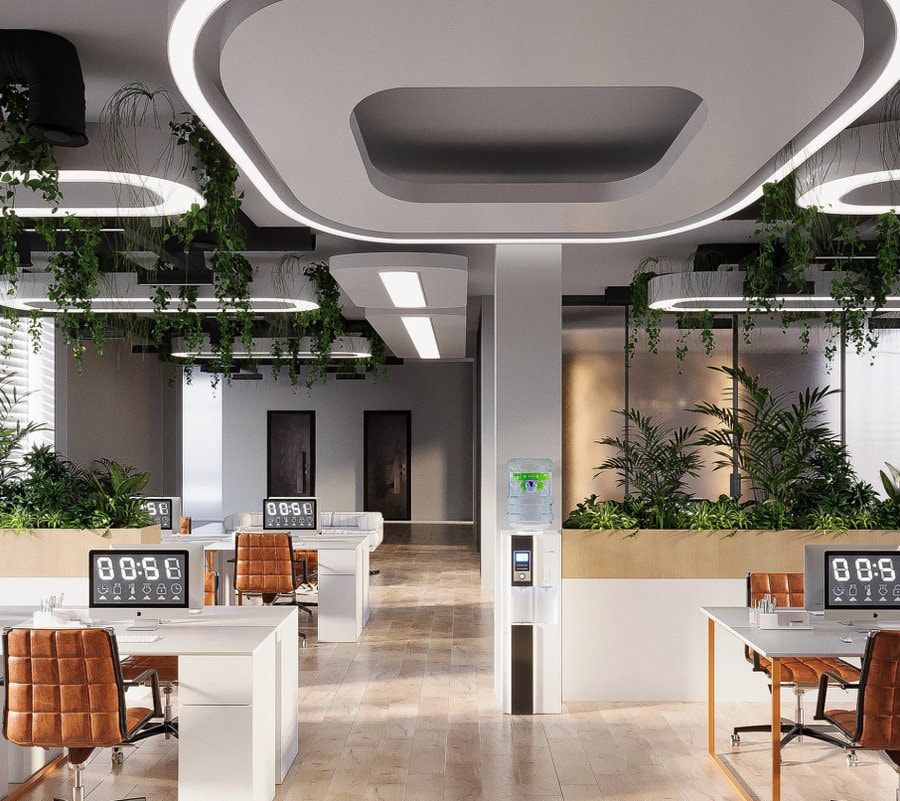
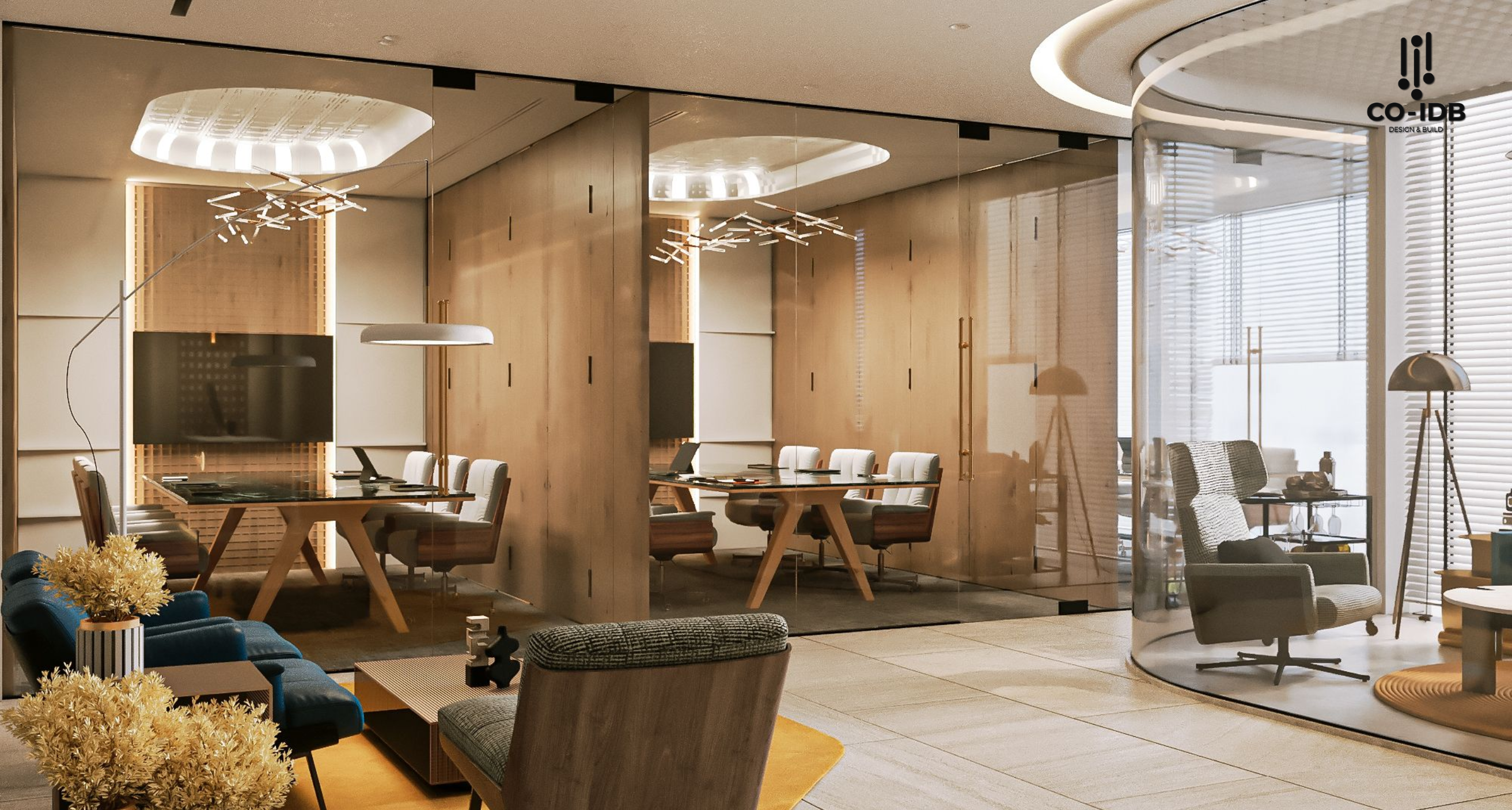
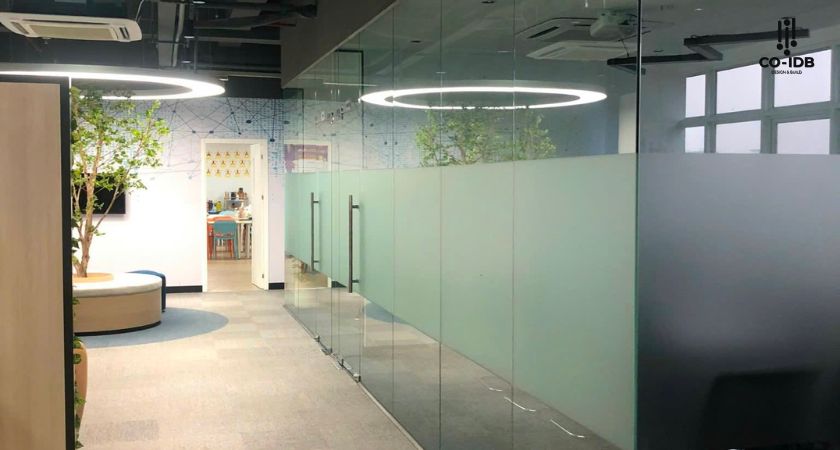
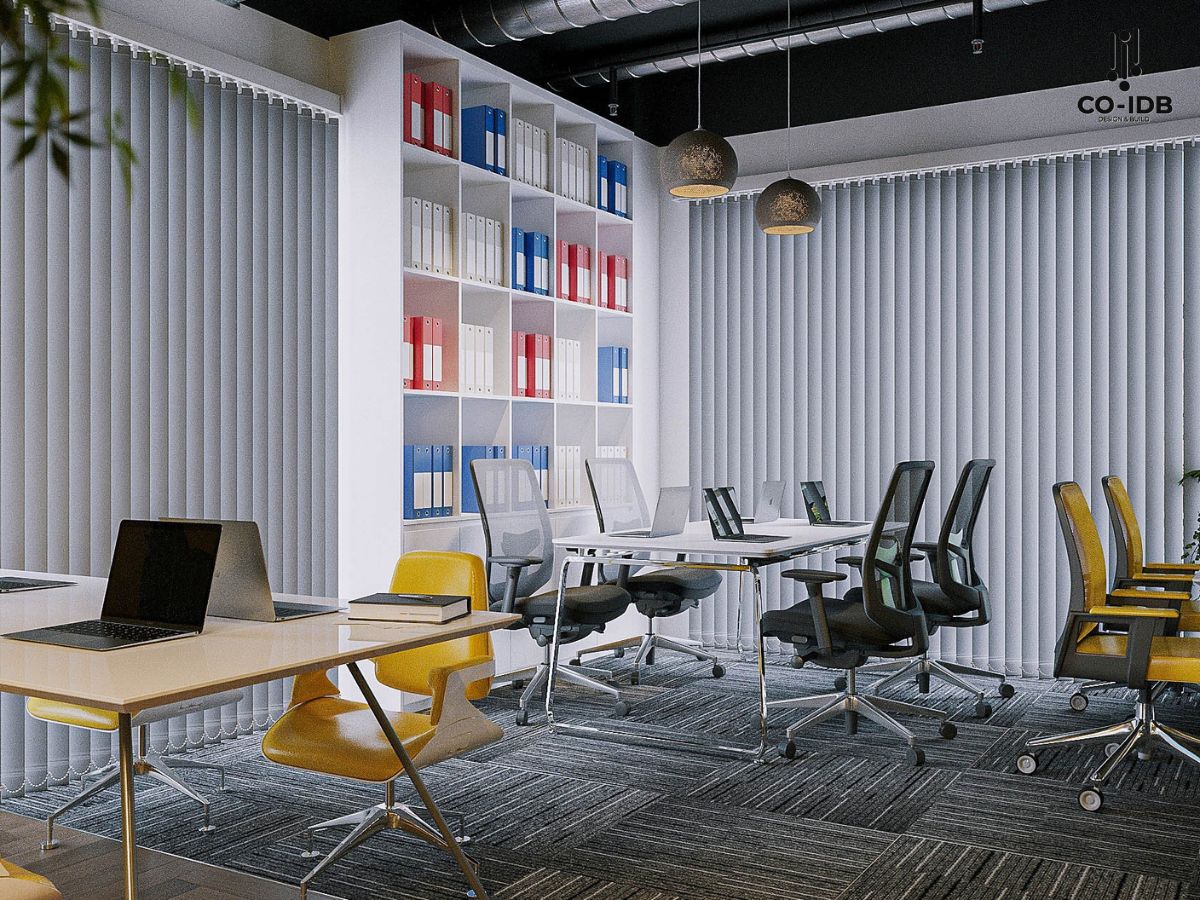
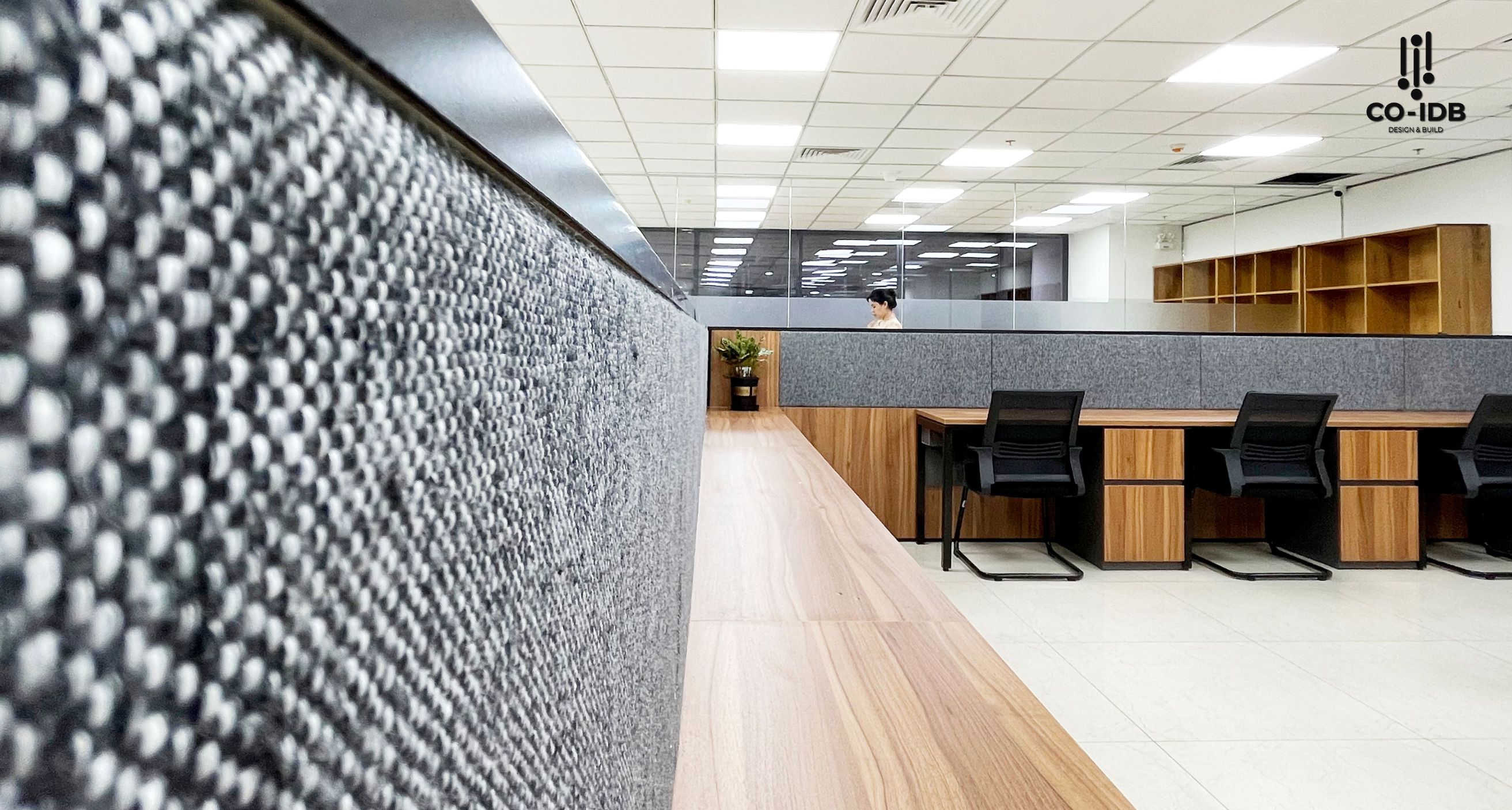
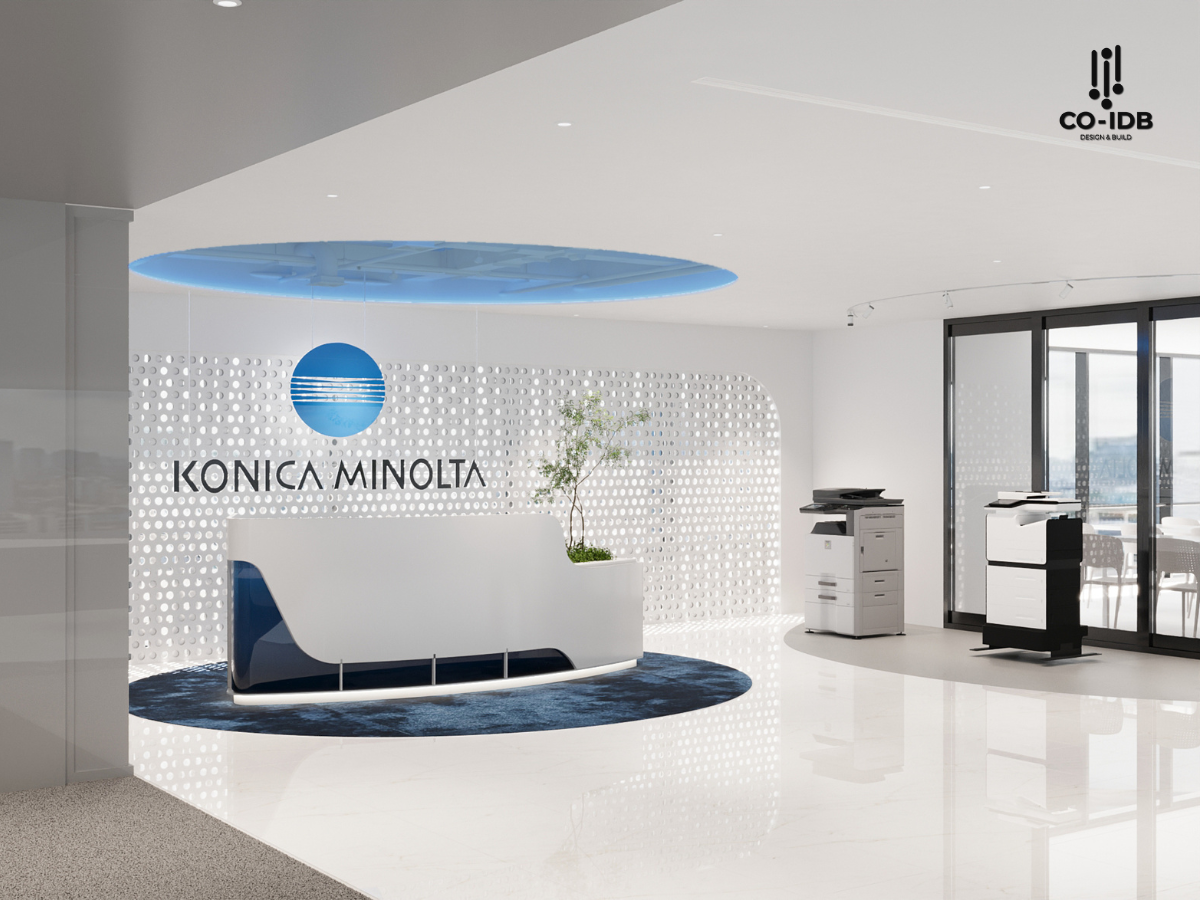
Lighting design in an office is not just a technical activity but also an art that creates a refined and luxurious workspace. Light provides the necessary illumination, has the ability to affect mood, create accents, and honor the beauty of the working environment. Let Co-IDB help you explore the principles and standards of effective lighting design to bring comfort and optimal performance to your office space!
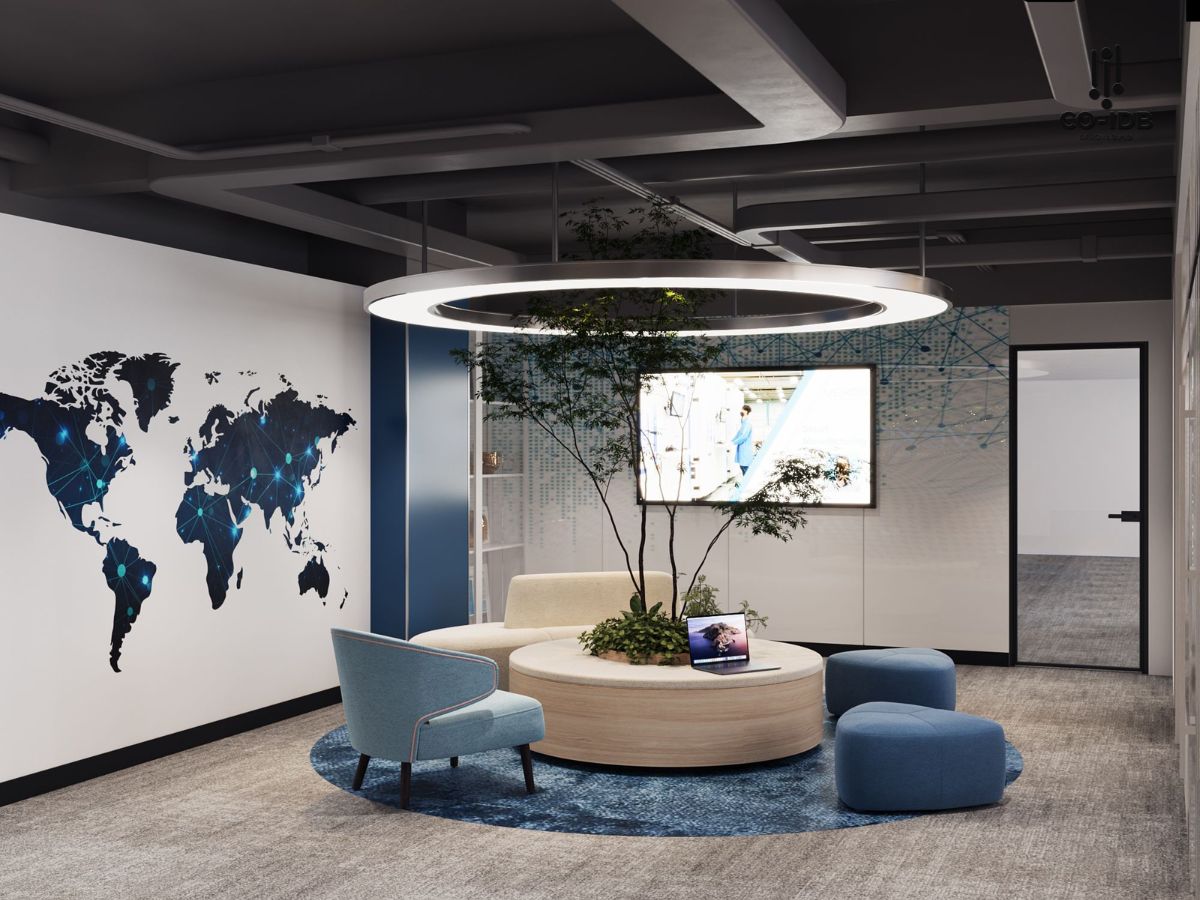
Parameters and Standards for Office Lighting Design
Illuminance
Illuminance, also known as luminous flux per unit area, is the index reflecting the level of brightness at a point in the office. Each task requires a suitable level of light to ensure eye comfort and enhance work efficiency.
Specifically, the lighting standard for an office workspace is 400 lux, while rest areas require about 150 lux. For reading, the ideal light level is between 300-500 lux. To optimize working conditions, adhering to these lighting standards is extremely necessary.
Illuminance is calculated by the formula: $E = \Phi/S$, where $E$ is illuminance (measured in lux), $\Phi$ is the total luminous flux (measured in lumens), and $S$ is the illuminated surface area (measured in square meters). Understanding and accurately applying these parameters will help create an ideal workspace for employees.

Color Rendering Index (CRI)
The Color Rendering Index is one of the important office lighting standards, reflecting the true color of the illuminated object in the office decoration. The ideal CRI is in the range of 80-100 Ra. If this index is low, it will affect the ability to recognize colors and not reflect the actual color of the product accurately.
Current high-end lighting fixtures require a CRI > 90 and must undergo strict inspection before leaving the factory. High-CRI LED lights are often used in areas requiring precise light, such as museums, product display shelves, and high-end living rooms. Therefore, when choosing lights for the office, prioritize high-CRI types to ensure the best working environment.

Color Temperature
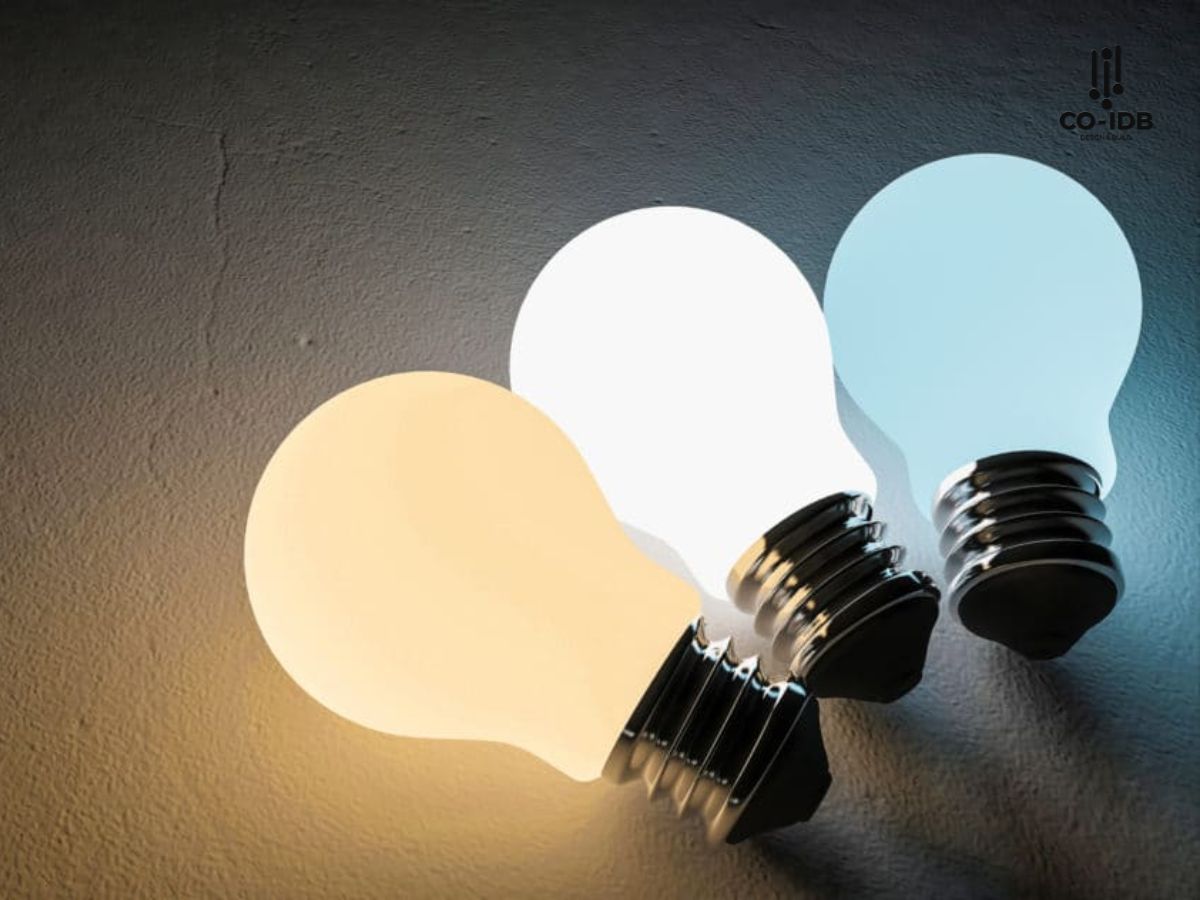
Color temperature is an important parameter that reflects the color of the light emitted from the lamp, helping to select a more suitable type of lamp. Color temperature is divided into three main groups:
-
Warm white light: below 3000K (common from old incandescent bulbs)
-
Neutral white light: approximately 4000 – 4500K
-
Cool white light: from 5000 – 6500K
For offices, cool white light is often recommended because it helps enhance focus and work performance. However, the choice of color temperature also depends on the type of office. Some smart offices today, such as MB Ageas, use lighting fixtures that can adjust color temperature via a smartphone app, providing flexibility for the workspace.
See more: Explore the interior materials of the modern, classy MB Ageas Project
Beam Angle of the Lamp
An important parameter in office lighting design is the beam angle. The beam angle is defined by the angle between two surfaces where the minimum light intensity is equal to 50% of the maximum light intensity in the central area. This indicates that the light intensity may not be uniform at all points in the space.
Depending on the type of office, businesses should choose lights with a suitable beam angle. Beam angles are divided into three types:
-
Narrow beam angle (3⁰, 5⁰, 8⁰): Often used for long-distance lighting, such as exterior building lighting.
-
Medium beam angle (10⁰, 15⁰, 24⁰, 36⁰): Common in spotlights, suitable for indirect lighting and creating accents.
-
Wide beam angle: Used to illuminate large areas, such as offices and common living spaces.
Natural Light
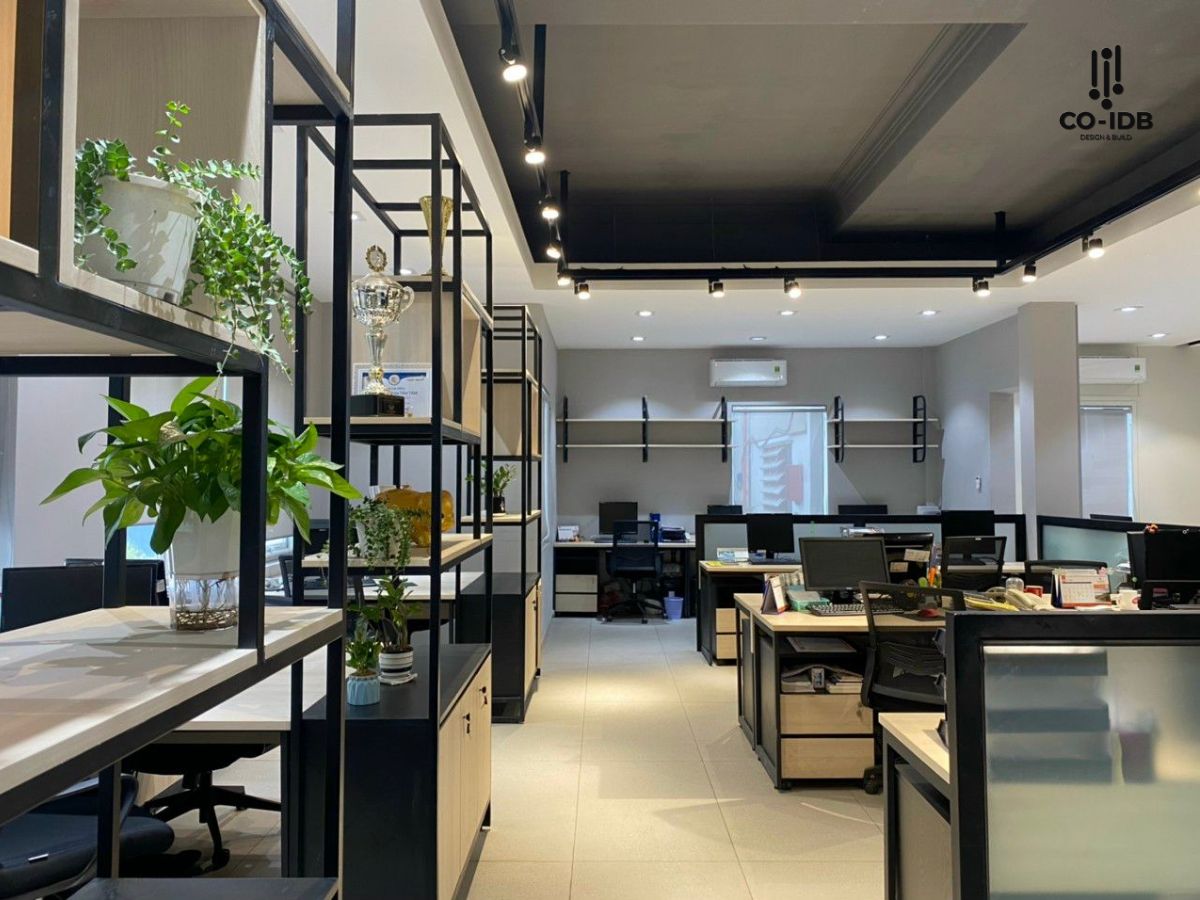
Natural light is the top priority light source in office design, helping to save energy and bring a sense of closeness to nature. Natural light helps create airiness, making the space feel more spacious and pleasant.
Light Distribution and Coordination
This standard regulates how light is distributed in the space, ensuring uniformity, avoiding glare, and unwanted shadows. A reasonable combination of natural and artificial light sources, as well as direct and indirect light, will create a harmonious and comfortable space.

Applications of Lighting Design
According to Wikipedia, appropriate lighting can enhance work performance, improve the appearance of an area, or have a positive psychological impact, specifically:
-
Increase work productivity: Suitable lighting helps improve concentration and work efficiency, reducing eye fatigue.
-
Create a comfortable space: Proper lighting helps create a pleasant atmosphere, boosting employee morale.
-
Define the space: Use light to highlight specific areas such as meeting rooms, reception areas, or common workspaces.
-
Enhance aesthetics: Light can highlight office interior design elements, creating beauty and style for the office.
-
Ensure safety: Proper lighting design helps illuminate walkways, staircases, and necessary areas to ensure employee safety.
-
Save energy: Combining natural light and energy-saving lighting technology will reduce energy costs for the office.
See more: Office interior design quotation categorized by small, medium, and large scale

What Methods are Included in Office Lighting Design?
KSD (Coefficient of Utilization) Method
This lighting method is highly suitable for calculating general lighting and lighting in workshops with an area greater than 10m².
Step 1: Determine the type of lighting fixture and the necessary light level for the surface in the room.
Step 2: Collect data according to the calculation table template.
Step 3: Calculate the room index using the formula:
Room Index = (Length x Width) / Height x (Length + Width)
Step 4: Calculate the Coefficient of Utilization using the formula:
Coefficient of Utilization = Lumen / Surface Area
Where Lumen is the parameter representing the light output emitted from the light source.
Step 5: Calculate the number of lamps needed using the formula: $N=(E \cdot A) / (F \cdot UF \cdot LLF)$
-
$N$: Number of lamps to be installed
-
$E$: Necessary lux level for the working surface
-
$A$: Area calculated as $L \times W$
-
$F$: Total lumen of the lamps in one fixture
-
$UF$: Utilization Factor (Coefficient of Utilization) based on the fixture type
-
$LLF$: Light Loss Factor, reflecting wear and tear over time and dirt on the surface.
Unit Power Method
For small rooms or areas that do not require high accuracy (room index < 0.5), the approximately accurate lighting calculation method can be applied. This method is based on unit power, calculating the lighting power per square meter (w/m²).
Step 1: Determine the illuminated area (m²) of the room or area.
Step 2: Calculate the necessary total power by multiplying the area by the desired unit power (w/m²). For example, if the area is $15m^2$ and the unit power is $25w/m^2$, the necessary total power will be $15m^2 \times 25\,w/m^2 = 375W$.
Step 3: Based on the total power, select the number and power of suitable lamps to achieve the desired total power. Businesses can also apply other calculation methods to re-check the results.

Steps for Office Lighting Design
Steps for Interior Lighting Design
To design an effective lighting system for the office, the following steps can be taken:
-
Step 1: Determine the purpose of useFirst, clearly define the purpose of use for each space, such as task lighting, general lighting, or accent lighting. At the same time, consider the emotion and atmosphere the business wants to bring to each area.
-
Step 2: Perform lighting calculationsProceed with the design calculation steps and consider the existing budget. Ensure that the lighting solutions align with the office’s goals and resources.
-
Step 3: Determine the number of lampsUse the formulas mentioned to determine the required number of lamps and select the appropriate light source for each space. Be sure to apply the formula corresponding to different areas.
-
Step 4: Finalize the design planFinally, complete the design plan with full information and light simulation drawings. This helps to clearly visualize how the light will work in the space, allowing for appropriate adjustments.
See more: Composition Rules in Office Interior Design

Steps for Exterior Lighting Design
To design a lighting system for outdoor spaces, similar steps can be applied as for indoor design. However, some specific points need attention:
-
Determine usage needs: First, clarify the business owner’s desires and needs for how the outdoor space will be used. This will help create a lighting system that meets the exact goals.
-
Refer to lighting standards: Research and refer to appropriate lighting standards for open outdoor spaces. Light needs to be distributed reasonably to ensure safety and create a comfortable atmosphere for users.

Lighting design in the office is not just the art of creating a beautiful space but also must comply with basic principles and standards. Hopefully, through the article, customers will gain creative ideas for office lighting design, bringing an optimal, comfortable, and efficient workspace. Contact Co-IDB to receive professional lighting design consultation.
>> See more: