In the context of rapid urbanization and the increasingly visible impacts of climate change, the concept of a “green office” is no longer just a trend but has become the new standard for workspace design in Vietnam. This article introduces the 5 most popular green building certifications for offices in Vietnam: LEED, LOTUS, Green Label, EDGE, and WELL. CO-IDB will analyze the pros and cons, suitability, and practical values these certifications bring to modern businesses.

The Importance of Green Certifications in Modern Vietnam
Green certifications play a pivotal role in promoting sustainable development in Vietnam. Amid rapid urbanization and strong economic growth, green standards guide the construction industry toward environmental friendliness and energy efficiency.
The Vietnamese government has recognized the importance of green building and has introduced various supportive policies. For instance, Decision No. 1393/QD-TTg on the National Strategy on Green Growth encourages the adoption of green standards in building construction and operation.
Green certifications offer numerous benefits to stakeholders:
|
Stakeholders |
Key Benefits |
|
Developers/Owners |
|
|
Tenants |
|
|
Community |
|
Applying green certifications contributes to raising environmental protection awareness within the business community and society. Simultaneously, it creates a new market for green products and services, driving the growth of the green industry in Vietnam.
Popular Green Certifications for Offices in Vietnam
Depending on budget, development goals, and branding strategy, businesses can choose one of the following 5 green certification systems:
LEED Certification
LEED (Leadership in Energy and Environmental Design) is a green building certification system developed by the U.S. Green Building Council (USGBC). LEED evaluates building performance based on criteria such as sustainable sites, water efficiency, energy and atmosphere, materials and resources, indoor environmental quality, and innovation in design.
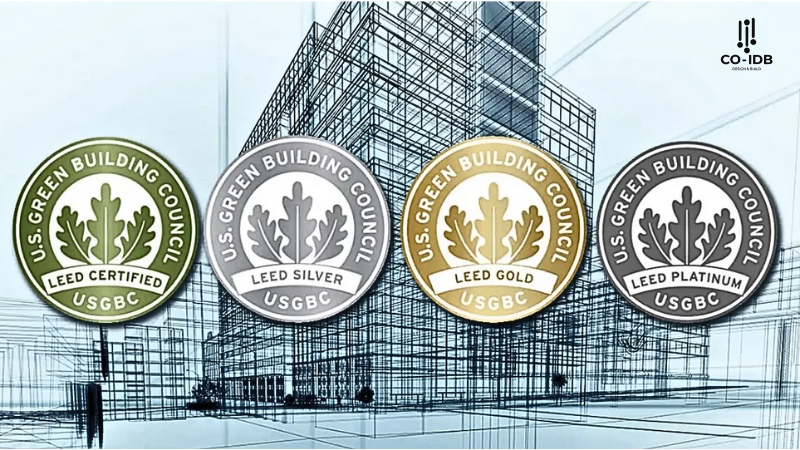
LEED Certification provides four certification levels:
-
Certified (40-49 points)
-
Silver (50-59 points)
-
Gold (60-79 points)
-
Platinum (80+ points)
LEED is highly favored in Vietnam due to its international prestige. However, assessment costs can be high for smaller projects.
Read more: 15+ Financial Office Design & Construction Projects meeting LEED standards
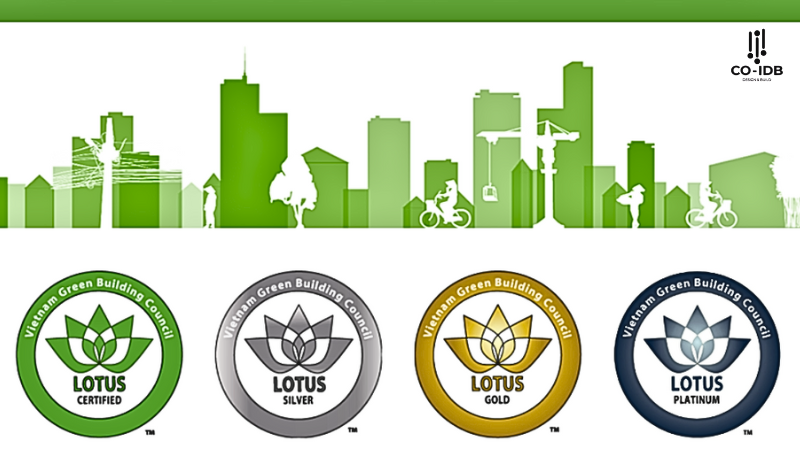
LOTUS Certification
LOTUS is a green building rating system developed by the Vietnam Green Building Council (VGBC). LOTUS is specifically designed to fit Vietnam’s climate conditions and building regulations while maintaining international standards.
LOTUS evaluates building performance based on:
-
Energy
-
Water
-
Materials
-
Ecology
-
Indoor Environmental Quality
-
Waste and Pollution
-
Adaptation and Mitigation
-
Community
LOTUS offers four certification levels: Certified, Silver, Gold, and Platinum. Its main advantage is its high relevance to the Vietnamese context and lower assessment costs compared to international equivalents.
Green Label Certification
Green Label is a certification program managed by the Vietnam Ministry of Construction. It focuses on evaluating the energy and environmental performance of office buildings and other public works.
Green Label criteria include: Energy efficiency, effective water use, waste management, indoor air quality, and green materials. Its advantage lies in a simplified evaluation process and low costs, making it suitable for SMEs in Vietnam.

EDGE Certification
EDGE (Excellence in Design for Greater Efficiencies) is a green certification system developed by the International Finance Corporation (IFC), a member of the World Bank Group. EDGE focuses primarily on resource efficiency in energy, water, and embodied energy in materials.
EDGE requires a building to achieve at least 20% savings in three areas. This certification is highly viable for emerging markets like Vietnam due to its low assessment costs and streamlined process.
Read more: 1000m² Office Models designed and constructed to green standards.
WELL Certification
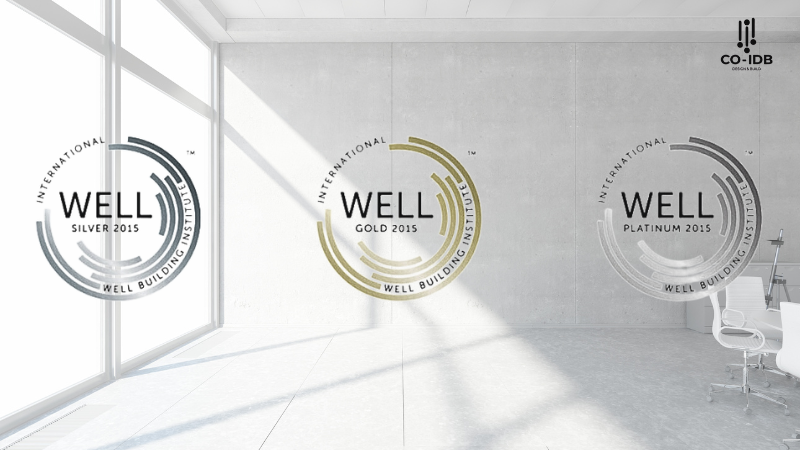
The WELL Building Standard focuses on the health and well-being of building occupants. WELL evaluates the built environment across seven concepts: Air, Water, Nourishment, Light, Fitness, Mind, and Comfort.
WELL provides three certification levels: Silver, Gold, and Platinum. It is particularly suitable for offices prioritizing employee wellness and productivity.
Read more: Well-being Trends in the Workspace
Detailed Comparison of Green Office Certifications in Vietnam
Each green certification has unique strengths and weaknesses, catering to different business needs and contexts.
| Cert. | Pros | Cons | Construction Feasibility | Investment | Best For |
| LEED | High global prestige, comprehensive standards | High assessment costs, may not perfectly fit local context | High – requires strict technical control | High | Corporations, large office chains |
| LOTUS | Tailored for Vietnam, reasonable cost | Less recognized internationally | Good – fits Vietnam’s infrastructure/climate | Medium | Domestic companies, long-term projects |
| Green Label | Simple, low cost, suitable for SMEs | Less comprehensive than international standards | Easy – simplified procedures | Low | Small & Medium Enterprises |
| EDGE | Focuses on resource efficiency | Does not cover all green aspects | Very Feasible – fits small/new projects | Low | Startups, growing businesses |
| WELL | Focuses on health & well-being | High cost, complex technical requirements | High – strict HVAC, lighting, interior rules | High | Human-centric cultures, employee focus |
Note from Co-IDB: When designing a green office, technical factors (materials, lighting, ventilation), operational space (open-close layout), and user experience (acoustics, comfort) must be calculated simultaneously. Integrating these criteria from the start saves much more time and cost than retrofitting after completion.
Benefits of Achieving Green Certification for Businesses
- Optimize Long-term Operating Costs: By using energy-saving solutions, smart lighting, and efficient ventilation, businesses can save 15–30% in annual costs.
- Enhance Brand Value & Talent Attraction: Green-certified spaces offer bright, airy, and convenient designs—a huge advantage in recruiting young talent and building a sustainable image.
- Boost ESG Scores – Better Access to Capital: For companies seeking partners or IPOs, green certification is a clear plus in ESG reports and sustainability performance.
The Process of Achieving Green Office Certification
- Preliminary Assessment: Identify goals and choose a suitable certification.
- Planning: Build an action plan to meet specific criteria.
- Design & Construction: Integrate green requirements into the interior design and build process.
- Data Collection: Record and compile building performance info.
- Registration: Submit documentation to the certification body.
- Audit: The body reviews files and performs site inspections.
- Certification: If standards are met, the building is certified.
- Maintenance: Continuously monitor and improve performance.

Read more: Professional Office Fit-out and Construction Process
Co-IDB – Your Trusted Partner in Green Office Design & Construction
With experience in projects ranging from startups to large corporations, CO-IDB is not just an interior construction unit but a strategic partner accompanying businesses in building sustainable workspaces.
We understand that green certifications from LEED to WELL are not just “labels”—they are strategic choices affecting how a business operates and how employees feel about their workplace every day.
>>> See more: